Journaling about nonfiction topics in 1st grade can provide numerous benefits. It helps them develop critical thinking skills, as they gather information and organize their thoughts. Writing about real-world subjects enhances their understanding of the world around them and builds their knowledge base. Additionally, it improves their ability to convey information clearly and logically, fostering effective communication. This practice also encourages curiosity and a love for learning, as they explore various subjects through their writing.
1. Enhancing Language Development
Journaling on a nonfiction topic helps a 1st grader develop Vocabulary and Language Skills by exposing them to new words and concepts. When students write about real-world subjects, they are likely to encounter unfamiliar words and ideas, which encourages them to learn and use these words in context. Additionally, explaining their thoughts and observations in writing helps them practice forming sentences that focus on the topic. Expressing themselves in this manner enhances their language development.
Carol Brennan Jenkins said, “With so much natural savvy when it comes to writing nonfiction, the authors realized that what students really need is technique oriented instruction to refine and build on what they already know.” BU Today
2. Using Word Banks
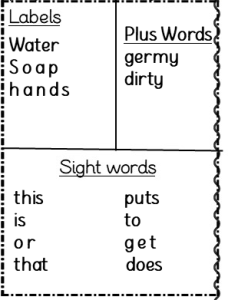
Using a word bank while journaling helps a 1st grader improve spelling by providing them with a reference for correctly spelled words. When they see the words in the Word Bank and use them in their writing, they reinforce the correct spelling patterns in their memory. Over time, this repetition and exposure to correctly spelled words can contribute to improved spelling skills as they become more confident in using these patterns in their writing.
3. Daily Journal Writing
When first graders are given the opportunity to write on a regular basis, their fine motor skills improve. As time goes by, you can see the difference in the letter and word formation. Save writing samples throughout the school year to see and show to parents how student writing has improved.
4. Self-Expression
Using nonfiction topics for the journal writing theme for first graders gives them the opportunity to use the background information that is given to them. They digest this information, use the topic vocabulary to write a response to a real-world subject and they apply the information they have learned.
5. Writing Improves
Should emergent Writers also be journal writing despite being unable to write a complete sentence or write decodable words? The answer is YES! The daily writing journals I have made provide a scaffold where they can build a sentence with words that have been provided related to the topic. But, they too need to be writing! As time passes on, you will also see their writing begin to be readable and begin to make sense. If this does not happen, your student may have a disability and you would have evidence to show parents and add to their file.
I have a set of Daily Journal Writing resources on Amped Up Learning and on Teachers Pay Teachers for you to take a look at.
Shelley Rees blogs about, Why Daily Writing Prompts Matter For You.
Nonfiction Writing Resource
Daily Writing Journal – Wash Your Hands
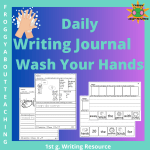
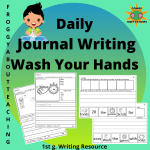
I have created a nonfiction writing resource for 1st graders that will them write about the importance of washing their hands.
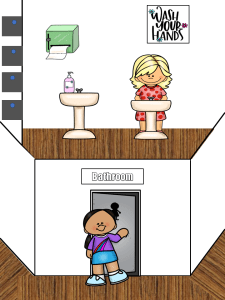
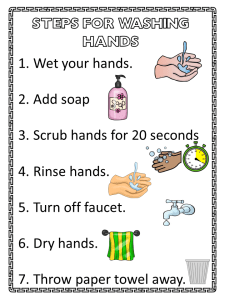
The Anchor Charts can be used to introduce this writing unit. There is a Bathroom Scene and Steps for Washing Hands.
Vocabulary Activities
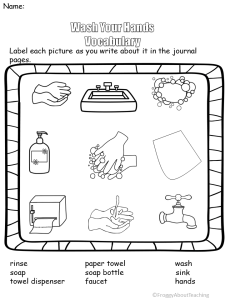
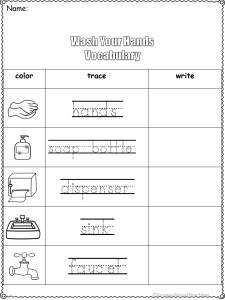
Students get vocabulary sheets where they trace the word, color the picture, and write the word. They also get a sheet where they label the pictures with the vocabulary words.
Background Information
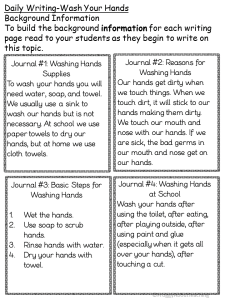
For each journal page there is a short paragraph with background information that is shared with the students. They are given information that is pertinent to their writing. This helps them to develop their critical thinking and directs the written response.
Differentiated
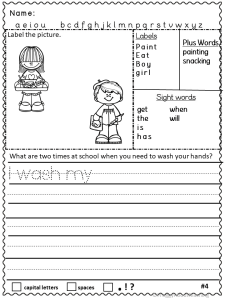
Transitional Writers are given a picture related to the topic that they will label, they have several word banks that provide some nouns, verbs, adverbs, and adjectives related to the topic. A sight word bank is also provided. Their journal pages also have a sentence starter to get these students writing.
Independent Writers have more writing independence. They can brainstorm word lists; they also label and write a caption about the picture. They are given a sight word bank.
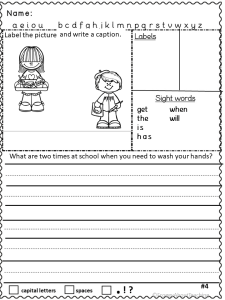
Both the transitional and independent journal pages have a letter bar to use to sound out words, a writing prompt to direct the writing, and a writing checklist.
Emergent Writers will probably need to be pulled into a small group. There is a Sentence Model for the teacher to use to demonstrate how to put the words together to make a sentence that makes sense. Then students can do the Make-a-Sentence sheet. As you see these students’ improve in building the sentences, then you can move them up the transitional journal pages.
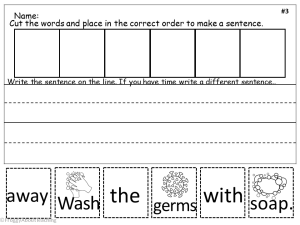
The journal pages are differentiated for your Emergent, Transitional, and Fluent writers. Notes are included for each Journal Page that the teacher can use to build the background information. You will appreciate this writing unit that emphasizes the importance of washing hands and getting the students to write about it.
This resource provides a technique that can be used to get our students to write about nonfiction topics. The background information that they need is given for each journal page. Students respond to the writing prompt using the given background information.
 Froggy About Teaching
Leave a comment